
Master in Pharmacy in Germany: Complete Guide for Students

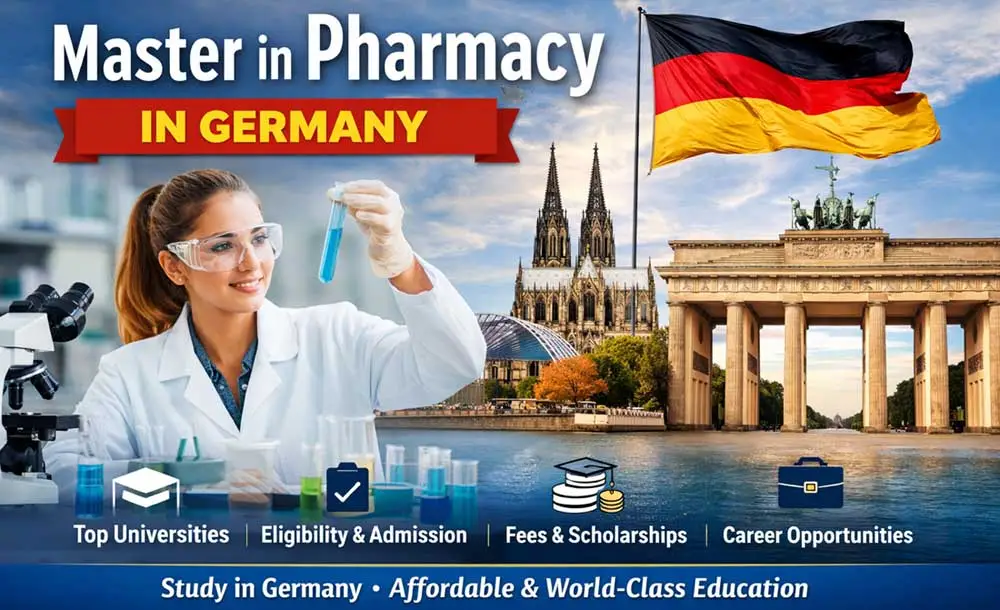
For many students who study pharmacy, the dream goes beyond just earning a degree. It is about understanding how medicines are developed, tested, approved, and used to improve lives. If you are thinking along these lines, pursuing a Master in Pharmacy in Germany can be a smart and rewarding decision.
Germany is known worldwide for its strong education system, advanced research facilities, and affordable public universities. Every year, thousands of international students choose Germany to continue their studies in pharmacy and pharmaceutical sciences. This guide explains everything you need to know, step by step, in simple and clear language.
What Is a Master in Pharmacy in Germany?
A Master in Pharmacy in Germany is a postgraduate degree that students pursue after completing a bachelor’s degree in pharmacy or a related science field. The program focuses on advanced pharmaceutical knowledge, research, and practical skills.
In Germany, pharmacy education is not limited to working behind a medical store counter. Instead, it strongly emphasizes science, research, technology, and industry exposure.
You may find programs under different names, such as:
- Master of Pharmacy
- MSc in Pharmaceutical Sciences
- MSc in Industrial Pharmacy
- MSc in Pharmaceutical Technology
- MSc in Pharmaceutical Medicine
All of these fall under the broader concept of a Master in Pharmacy in Germany, though each has a slightly different focus.
Most programs are 1.5 to 2 years long and include coursework, laboratory training, research projects, and a master’s thesis.
Why Study Master in Pharmacy in Germany?
Germany has become one of the most preferred destinations for pharmacy students, and the reasons are practical, not just promotional.
High-Quality Education
German universities are known for their strong academic standards. Pharmacy programs focus on understanding concepts deeply rather than memorizing facts. Students spend significant time in laboratories and research environments.
Affordable Education
One of the biggest advantages is cost. Most public universities in Germany charge no tuition fees, even for international students. You usually pay only a small semester contribution, which covers administration and public transport.
This makes studying pharmacy in Germany far more affordable than countries like the USA, UK, or Australia.
Strong Pharmaceutical Industry
Germany has a powerful pharmaceutical and biotechnology industry. Many universities work closely with research institutes and companies, which helps students gain real-world exposure.
Post-Study Career Opportunities
After completing a Master in Pharmacy in Germany, international students are allowed to stay back and search for jobs. If you find suitable employment, you can continue working and building your career in Germany.
Types of Master in Pharmacy Programs in Germany
Choosing the right program depends on your background and career goals.
Traditional Master of Pharmacy
These programs focus on advanced pharmaceutical sciences and research. Many of them are taught in German and are suitable for students interested in research, teaching, or doctoral studies.
Master in Pharmaceutical Sciences
These programs are very popular among international students and are often taught entirely in English. They focus on drug discovery, pharmacology, molecular biology, and pharmaceutical analysis.
Master in Industrial Pharmacy
This option is ideal for students who want to work in pharmaceutical companies. The focus is on manufacturing, quality control, regulatory affairs, and pharmaceutical technology.
Master in Pharmaceutical Medicine
This is a specialized program that deals with clinical trials, drug safety, regulatory science, and medical research. It is suitable for students interested in clinical and regulatory roles rather than retail pharmacy.
Eligibility Criteria
While requirements vary slightly by university, most institutions expect the following:
Academic Background
You should have:
- A Bachelor’s degree in Pharmacy (BPharm), or
- A related degree in pharmaceutical sciences, biotechnology, chemistry, or life sciences
Your degree must be equivalent to German academic standards.
Language Requirements
For English-taught programs, you usually need:
- IELTS score of around 6.5, or
- Equivalent TOEFL score
For German-taught programs, you need German language proficiency such as:
- TestDaF or
- DSH at B2 or C1 level
Even if your course is in English, learning basic German is strongly recommended for daily life and future job opportunities.
APS Certificate (For Indian Students)
Indian students are generally required to obtain an APS certificate, which verifies academic documents for German universities and visa applications.
Application Process
Applying for a Master in Pharmacy in Germany becomes much easier when done step by step.
- Shortlist universities and programs that match your profile
- Check eligibility and language requirements carefully
- Prepare documents such as transcripts, CV, SOP, and recommendations
- Apply through the university portal or via Uni-Assist
- Receive your admission letter
- Apply for a German student visa
- Arrange accommodation, blocked account, and health insurance
Starting early improves your chances of admission and smooth visa processing.
Cost of Studying and Living in Germany
Tuition Fees
- Public universities: Mostly free or minimal semester fees
- Private universities: Around €10,000 to €20,000 per year
Living Expenses
Students usually need €800 to €1,200 per month, covering:
- Rent
- Food
- Transport
- Health insurance
- Personal expenses
Students are allowed to work part-time while studying, which helps manage costs.
Top Universities for Master in Pharmacy in Germany
Below are some well-known public and private universities offering pharmacy or pharmacy-related master’s programs.
Top Public Universities
These universities are government-funded and usually charge very low or no tuition fees.
- University of Heidelberg – Strong focus on pharmaceutical research and life sciences
- University of Freiburg – Known for pharmacy, drug technology, and biomedical research
- Ludwig Maximilian University of Munich (LMU) – One of Germany’s top-ranked universities
- Technical University of Munich (TUM) – Excellent life science and biotechnology programs
- University of Tübingen – Research-oriented pharmaceutical and medical sciences
- Johannes Gutenberg University Mainz – Well-regarded pharmacy and pharmaceutical science programs
- Freie Universität Berlin – Strong academic reputation and international environment
- University of Bonn – Focus on experimental and applied pharmaceutical sciences
Top Private Universities
Private universities usually charge tuition fees but often offer English-taught, industry-focused programs.
- Hochschule Fresenius (University of Applied Sciences) – Known for Pharmaceutical Medicine and applied pharmacy programs
- SRH University Heidelberg – Focus on health sciences and pharmaceutical applications
- Berlin International University of Applied Sciences – Modern, international programs in life sciences
- Munich International University (MIU) – Practical, industry-oriented master’s programs
- IU International University of Applied Sciences – Health and pharmaceutical-related programs with flexible study options
Scholarships and Financial Support
Although public education is affordable, scholarships can help cover living costs. Popular options include:
- DAAD scholarships
- University-specific scholarships
- Research assistantships and funded projects
Applying early and having a strong academic profile increases your chances.
What You Study During the Program
Course content may vary, but generally includes:
- Advanced pharmacology
- Drug formulation and development
- Pharmaceutical chemistry
- Quality assurance and regulatory affairs
- Laboratory research and practical training
- Master’s thesis
The focus is on understanding concepts and applying them in real-world scenarios.
Career Opportunities After Graduation
After completing a Master in Pharmacy in Germany, graduates can work as:
- Pharmaceutical research scientists
- Quality control or quality assurance professionals
- Clinical research associates
- Regulatory affairs specialists
- Drug development experts
Many students also continue with a PhD or stay in Germany for long-term employment.
Student Life in Germany
Germany offers a safe, structured, and student-friendly environment. Students enjoy:
- Affordable public transport
- Multicultural campuses
- Clean and organized cities
- Student discounts and support services
Learning German helps you integrate better and opens more career opportunities.
Final Thoughts
A Master in Pharmacy in Germany is more than just an academic qualification. It is a chance to study in a country that values science, research, and quality education while keeping costs low.
With proper planning, the right university choice, and timely applications, Germany can be an excellent place to shape your future in pharmacy and pharmaceutical sciences.
Top FAQ on Master in Pharmacy in Germany
Yes, Germany is one of the best countries for a Master in Pharmacy. It offers high-quality education, strong research facilities, low or no tuition fees at public universities, and excellent career opportunities in the pharmaceutical industry.
To apply, you usually need a Bachelor’s degree in Pharmacy or a related field such as pharmaceutical sciences, biotechnology, or chemistry. You also need proof of English or German language proficiency, depending on the program. Indian students typically need an APS certificate.
Yes, many Master in Pharmacy and Pharmaceutical Sciences programs in Germany are taught fully in English. However, some traditional pharmacy programs are taught in German. Always check the language of instruction before applying.
Most Master in Pharmacy programs in Germany last 18 months to 2 years, including coursework, laboratory training, and a master’s thesis.
At public universities, tuition fees are usually free or very low. Students only pay a small semester fee. Private universities charge higher fees, usually between €10,000 and €20,000 per year. Living costs range from €800 to €1,200 per month.
German is not mandatory if you choose an English-taught program. However, learning basic German is strongly recommended for daily life, internships, and job opportunities after graduation.
Yes, international students are allowed to work up to 120 full days or 240 half days per year while studying in Germany. This helps students gain experience and manage living expenses.
Graduates can work in pharmaceutical companies, research laboratories, clinical research organizations, regulatory affairs, quality control, and drug development. Many students also continue with a PhD or stay in Germany for long-term employment.
Top public universities include Heidelberg University, University of Freiburg, LMU Munich, Technical University of Munich, and University of Tübingen. Popular private universities include Hochschule Fresenius, SRH University Heidelberg, and IU International University of Applied Sciences.
Yes, after completing your degree, you can apply for a post-study residence permit to look for a job in Germany. Once you secure employment related to your field, you can continue working and apply for long-term residence options.