Post Graduate Diploma in Risk Management

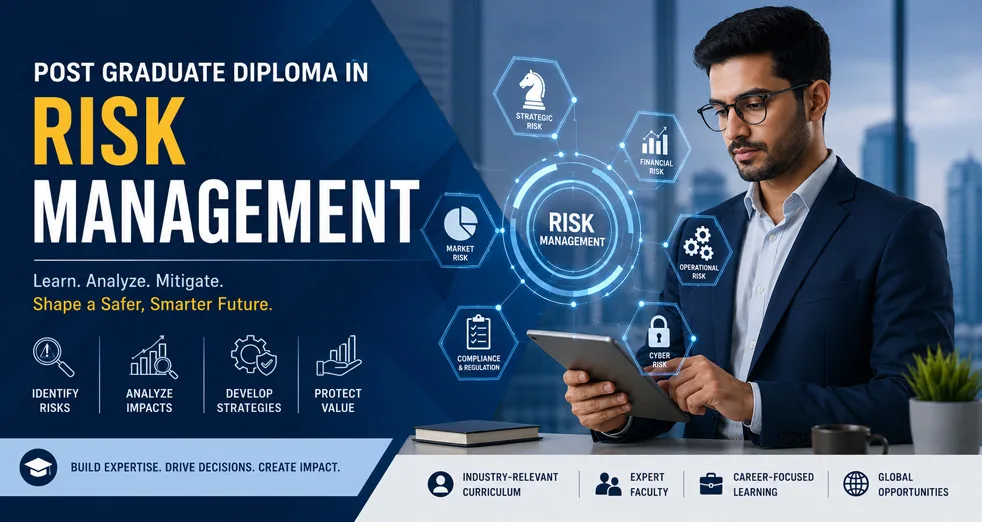
Post Graduate Diploma in Risk Management: A Complete Guide to Building a Successful Career in Risk and Financial Management
In today’s rapidly evolving business environment, organizations face an increasing number of financial, operational, cyber, regulatory, and strategic risks. From multinational corporations and banks to healthcare institutions and technology startups, every organization needs professionals who can identify potential risks, assess their impact, and implement strategies to minimize losses. This growing demand has made the Post Graduate Diploma in Risk Management one of the most promising professional programs for graduates seeking a rewarding and future-ready career.
Risk management has transformed from being a compliance-focused function into a strategic business discipline. Modern businesses rely on risk professionals to make informed decisions, ensure regulatory compliance, protect organizational assets, and build resilience against uncertainties. Whether it’s managing investment portfolios, protecting digital infrastructure from cyber threats, or ensuring operational continuity during disruptions, risk managers play a crucial role in organizational success.
A Post Graduate Diploma in Risk Management equips students with the theoretical knowledge and practical skills required to identify, evaluate, monitor, and mitigate various types of business risks. The program blends finance, analytics, compliance, governance, technology, and strategic decision-making, preparing graduates for careers across diverse industries.
If you’re considering a career in finance, insurance, banking, consulting, compliance, cybersecurity, or enterprise risk management, this guide will help you understand everything about pursuing a Post Graduate Diploma in Risk Management, including eligibility, curriculum, career opportunities, salary prospects, and future growth.
What is a Post Graduate Diploma in Risk Management?
A Post Graduate Diploma in Risk Management (PGDRM) is a specialized postgraduate program designed to prepare professionals to identify, analyze, evaluate, and manage risks across different business functions. The course focuses on developing analytical thinking, problem-solving abilities, and decision-making skills to help organizations navigate uncertainty effectively.
Unlike traditional management programs that cover broad business concepts, a Post Graduate Diploma in Risk Management concentrates specifically on risk assessment, financial risk, operational risk, regulatory compliance, governance, business continuity, and enterprise risk management.
The curriculum typically combines academic learning with industry-oriented training through case studies, simulations, projects, internships, and interactions with experienced professionals.
Students gain practical exposure to real-world business scenarios, enabling them to understand how organizations assess risk before making strategic decisions.
Why Risk Management Matters More Than Ever
The modern business landscape is more interconnected and complex than ever before. Organizations face numerous challenges, including:
- Economic uncertainty
- Financial market volatility
- Cybersecurity threats
- Climate-related risks
- Regulatory changes
- Supply chain disruptions
- Data privacy concerns
- Fraud and financial crimes
- Technological disruptions
- Geopolitical instability
These risks can significantly impact an organization’s financial performance, reputation, and long-term sustainability.
Risk management helps organizations:
- Identify potential threats before they occur.
- Reduce financial losses.
- Improve operational efficiency.
- Enhance regulatory compliance.
- Protect organizational reputation.
- Improve strategic planning.
- Build business resilience.
- Support informed decision-making.
As organizations increasingly adopt proactive risk management practices, the demand for qualified professionals continues to rise across industries.
Why Choose a Post Graduate Diploma in Risk Management?
Choosing a Post Graduate Diploma in Risk Management can be a strategic decision for graduates and working professionals looking to build expertise in a high-demand domain.
Some of the major advantages include:
1. Growing Industry Demand
Organizations across sectors are investing heavily in risk management to protect their operations and comply with evolving regulations. This has created consistent demand for skilled professionals.
2. Diverse Career Opportunities
Graduates are not limited to one industry. Risk management professionals work across:
- Banking
- Financial Services
- Insurance
- FinTech
- Consulting
- Manufacturing
- Information Technology
- Healthcare
- Energy
- Telecommunications
- Government Organizations
- Logistics
- Aviation
- Retail
- E-commerce
This versatility makes the qualification valuable across multiple sectors.
3. Attractive Salary Potential
Risk management professionals often receive competitive compensation due to the specialized nature of their work.
As professionals gain certifications, industry experience, and technical expertise, their earning potential increases significantly.
4. Global Career Opportunities
Risk management principles are universally applicable, creating opportunities to work with multinational corporations, international banks, consulting firms, insurance companies, and global financial institutions.
Professionals with expertise in enterprise risk management, financial risk, and regulatory compliance are particularly sought after in international markets.
5. Future-Proof Career
Technological advancements, stricter regulations, cyber threats, and increasing financial complexities continue to drive the demand for skilled risk professionals.
Rather than replacing risk professionals, artificial intelligence and automation are enhancing their capabilities by providing better data analysis and predictive insights.
Who Should Pursue a Post Graduate Diploma in Risk Management?
This program is suitable for individuals who enjoy analytical thinking, problem-solving, and strategic decision-making.
It is particularly beneficial for:
- Commerce graduates
- Business administration graduates
- Economics students
- Engineering graduates
- Mathematics and Statistics graduates
- Finance professionals
- Banking professionals
- Insurance professionals
- Chartered Accountancy aspirants
- Company Secretary professionals
- Working professionals looking to specialize
Even candidates from non-finance backgrounds can pursue the program if they are interested in understanding business risks and developing management expertise.
Eligibility Criteria
The eligibility requirements for a Post Graduate Diploma in Risk Management may vary across institutions. However, most institutes generally require:
- A bachelor’s degree from a recognized university.
- Graduation in any discipline, depending on the institution’s admission policy.
- Minimum qualifying marks as specified by the institute.
- Some institutions may prefer candidates with work experience, though it is not always mandatory.
- Admission may involve entrance tests, interviews, or aptitude assessments.
Prospective students should always check the specific admission requirements of the institution they are applying to.
Admission Process
The admission process for a Post Graduate Diploma in Risk Management generally involves the following steps:
Step 1: Submit an Application
Candidates complete the application form along with academic documents and identity proofs.
Step 2: Eligibility Screening
Institutions review the applicant’s educational qualifications and other eligibility criteria.
Step 3: Entrance Assessment (if applicable)
Some institutes conduct aptitude tests to evaluate analytical ability, quantitative skills, communication, and logical reasoning.
Step 4: Personal Interview
Shortlisted candidates may be invited for an interview to assess their motivation, communication skills, and career aspirations.
Step 5: Final Selection
Successful candidates receive an admission offer after completing the selection process and document verification.
Course Duration
Most Post Graduate Diploma in Risk Management programs are designed to be completed within one to two years, depending on the institute, curriculum structure, and mode of study.
Programs may be offered in:
- Full-time
- Part-time
- Weekend
- Executive
- Hybrid
- Online learning formats
Flexible learning options make it easier for working professionals to upgrade their skills while continuing their careers.
Post Graduate Diploma in Risk Management: A Complete Guide (Part 2)
In Part 1, we explored what a Post Graduate Diploma in Risk Management is, its importance, eligibility criteria, admission process, and why it has become one of the fastest-growing career options in today’s business landscape.
Now, let’s dive deeper into the curriculum, subjects, practical learning, skills, and career opportunities offered by a Post Graduate Diploma in Risk Management.
What Will You Learn in a Post Graduate Diploma in Risk Management?
A well-designed Post Graduate Diploma in Risk Management combines business fundamentals with specialized risk management concepts. The curriculum is designed to help students understand how organizations identify, evaluate, monitor, and mitigate risks while supporting strategic business decisions.
Unlike general management programs, PGDRM focuses on practical applications through case studies, simulations, live projects, internships, and industry interactions.
Students graduate with both conceptual understanding and hands-on exposure to solving real-world business challenges.
Core Subjects Covered in a Post Graduate Diploma in Risk Management
Although the syllabus varies across institutions, most programs include the following major areas of study.
1. Principles of Risk Management
This foundational subject introduces students to the concept of risk and its significance in modern organizations.
Topics generally include:
- Risk identification
- Risk assessment
- Risk analysis
- Risk mitigation
- Risk monitoring
- Risk reporting
- Risk appetite and tolerance
- Risk governance
Students learn how organizations establish structured frameworks to manage uncertainty effectively.
2. Enterprise Risk Management (ERM)
Enterprise Risk Management is one of the most important components of the program.
Rather than managing risks individually, ERM helps organizations evaluate risks holistically across departments.
Students learn about:
- Enterprise-wide risk assessment
- Risk governance structures
- Strategic risk planning
- Organizational resilience
- Risk culture
- Integrated risk frameworks
This subject prepares students to align risk management with organizational objectives.
3. Financial Risk Management
Financial institutions constantly deal with uncertainties related to markets, investments, and lending activities.
This subject focuses on:
- Credit risk
- Market risk
- Liquidity risk
- Interest rate risk
- Foreign exchange risk
- Investment risk
- Portfolio risk
Students also gain an understanding of financial modeling and risk measurement techniques.
4. Operational Risk Management
Operational risks arise from failures in internal processes, systems, or human errors.
Students learn how organizations reduce operational losses through:
- Process improvement
- Internal controls
- Incident reporting
- Fraud prevention
- Business continuity planning
- Operational resilience
Operational risk management has become increasingly important in banking, healthcare, manufacturing, and technology sectors.
5. Regulatory Compliance and Governance
Modern organizations operate under numerous legal and regulatory frameworks.
This subject introduces:
- Corporate governance
- Regulatory compliance
- Ethical business practices
- Internal audits
- Compliance monitoring
- Governance frameworks
Understanding regulatory expectations helps organizations avoid penalties and reputational damage.
6. Cyber Risk Management
As businesses become increasingly digital, cyber threats have become one of the biggest organizational risks.
Students learn:
- Cybersecurity fundamentals
- Information security risks
- Data privacy
- Cyber incident response
- Digital risk assessment
- Security governance
This area has gained tremendous importance across financial institutions and multinational corporations.
7. Business Continuity and Disaster Recovery
Unexpected events such as natural disasters, pandemics, cyberattacks, or system failures can severely disrupt business operations.
Students study:
- Business continuity planning
- Disaster recovery strategies
- Crisis communication
- Emergency response
- Operational resilience
Organizations increasingly prioritize professionals capable of ensuring uninterrupted business operations.
8. Quantitative Risk Analysis
Risk professionals often rely on statistical models to estimate future uncertainties.
Students learn:
- Probability concepts
- Statistical analysis
- Forecasting models
- Predictive analytics
- Risk measurement techniques
- Data interpretation
Strong quantitative skills enable better decision-making based on evidence rather than assumptions.
9. Insurance and Risk Transfer
Insurance remains one of the primary methods of managing organizational risk.
Students gain insights into:
- Insurance principles
- Risk transfer mechanisms
- Corporate insurance
- Claims management
- Underwriting basics
- Reinsurance concepts
This subject is particularly valuable for careers in insurance and financial services.
10. Strategic Risk Management
Organizations face long-term strategic risks related to competition, innovation, technology, and changing customer expectations.
Students learn how leaders evaluate:
- Competitive risks
- Market disruptions
- Innovation risks
- Reputation management
- Strategic planning
- Decision-making under uncertainty
Strategic thinking distinguishes senior risk professionals from operational specialists.
Practical Learning Components
One of the biggest strengths of a Post Graduate Diploma in Risk Management is its emphasis on experiential learning.
Many institutions incorporate:
- Live business projects
- Industry case studies
- Simulation exercises
- Group discussions
- Research assignments
- Capstone projects
- Internship opportunities
- Corporate interactions
- Guest lectures by industry experts
These practical experiences help students bridge the gap between classroom concepts and workplace realities.
Skills You Develop During a Post Graduate Diploma in Risk Management
Beyond technical knowledge, the program helps students build a wide range of transferable skills that are highly valued by employers.
Analytical Thinking
Risk professionals must evaluate large amounts of data, identify patterns, and recommend appropriate actions.
Decision-Making
Organizations rely on risk experts to support strategic decisions under uncertain conditions.
Problem-Solving
Students learn structured approaches to solving complex business challenges through systematic risk assessment.
Communication Skills
Risk findings must often be presented to senior management, regulators, and stakeholders in a clear and actionable manner.
Financial Analysis
Understanding financial statements, investment decisions, and business performance is essential for evaluating organizational risks.
Data Interpretation
Modern risk management increasingly depends on interpreting business intelligence, dashboards, and predictive analytics.
Regulatory Awareness
Professionals gain familiarity with compliance frameworks and governance standards applicable across industries.
Leadership and Collaboration
Risk management requires coordination with finance, operations, IT, legal, and executive leadership teams.
Students therefore develop cross-functional collaboration skills.
Technology Used in Risk Management
Today’s risk professionals work extensively with digital tools to assess and monitor organizational risks.
Depending on the institution and employer, exposure may include:
- Microsoft Excel (Advanced Analytics)
- Power BI
- Tableau
- SQL
- Python for data analysis
- Risk analytics software
- Governance, Risk, and Compliance (GRC) platforms
- Business Intelligence tools
- Financial modeling applications
Having technical proficiency alongside business knowledge significantly improves employability.
Career Opportunities After a Post Graduate Diploma in Risk Management
One of the biggest advantages of pursuing a Post Graduate Diploma in Risk Management is the wide range of career opportunities available across industries.
Graduates can pursue roles such as:
Risk Analyst
Analyzes organizational risks and recommends mitigation strategies based on quantitative and qualitative assessments.
Enterprise Risk Manager
Develops organization-wide risk management frameworks aligned with business objectives.
Credit Risk Analyst
Evaluates the creditworthiness of borrowers and helps financial institutions minimize lending risks.
Market Risk Analyst
Assesses risks arising from fluctuations in financial markets, interest rates, currencies, and investments.
Operational Risk Manager
Identifies operational inefficiencies and implements controls to reduce business disruptions.
Compliance Officer
Ensures organizations comply with applicable laws, regulations, and internal policies.
Internal Auditor
Evaluates organizational processes, identifies control weaknesses, and recommends improvements.
Business Continuity Specialist
Develops strategies that enable organizations to continue operations during emergencies and unexpected disruptions.
Fraud Risk Analyst
Investigates financial fraud risks and develops preventive measures.
Cyber Risk Consultant
Works with technology teams to assess digital threats and strengthen cybersecurity governance.
ESG Risk Analyst
With the rise of Environmental, Social, and Governance (ESG) reporting, organizations increasingly hire specialists to evaluate sustainability-related risks.
Risk Consultant
Consulting firms hire professionals who advise clients on improving governance, compliance, operational resilience, and enterprise risk management frameworks.
Industries Hiring Risk Management Professionals
The demand for graduates with a Post Graduate Diploma in Risk Management extends far beyond banking and insurance. Organizations across multiple sectors require professionals who can identify, evaluate, and mitigate risks effectively.
Some of the top hiring industries include:
Banking and Financial Services
Banks employ risk professionals for credit risk, market risk, operational risk, fraud prevention, regulatory compliance, and investment management.
Insurance
Insurance companies hire specialists in underwriting, claims analysis, actuarial support, enterprise risk, and compliance.
Consulting Firms
Management consulting and advisory firms help businesses improve governance, internal controls, and risk management frameworks.
Information Technology
Technology companies increasingly focus on cybersecurity, data privacy, cloud security, and operational resilience.
Healthcare
Hospitals and healthcare organizations require risk professionals to ensure patient safety, regulatory compliance, and operational continuity.
Manufacturing
Manufacturers manage supply chain risks, workplace safety, quality assurance, and operational disruptions.
Energy and Infrastructure
Large infrastructure projects involve financial, environmental, regulatory, and operational risks that require specialized expertise.
Government and Public Sector
Government agencies employ risk professionals for public finance, disaster management, cybersecurity, and governance initiatives.
Post Graduate Diploma in Risk Management: A Complete Guide (Part 3)
In Part 2, we explored the curriculum, core subjects, practical learning, essential skills, career roles, and industries that actively recruit graduates with a Post Graduate Diploma in Risk Management.
In this section, we’ll examine salary expectations, career progression, global opportunities, industry certifications, and compare a Post Graduate Diploma in Risk Management with an MBA to help you make an informed career decision.
Salary After a Post Graduate Diploma in Risk Management
One of the biggest reasons students choose a Post Graduate Diploma in Risk Management is the strong earning potential associated with this specialized field. As businesses place greater emphasis on governance, compliance, financial stability, and cybersecurity, organizations are willing to invest in professionals who can effectively manage risk.
Salary packages vary depending on several factors, including:
- Educational background
- Institute reputation
- Industry
- Job role
- Technical skills
- Professional certifications
- Location
- Work experience
Average Salary in India
While salaries differ across sectors, the following ranges provide a general overview:
| Experience Level | Estimated Annual Salary |
|---|---|
| Entry-Level (0–2 years) | ₹4 – ₹8 LPA |
| Mid-Level (3–7 years) | ₹8 – ₹18 LPA |
| Senior Professionals (8–15 years) | ₹18 – ₹35+ LPA |
| Leadership Roles | ₹35 LPA and above |
Professionals employed by multinational corporations, global consulting firms, investment banks, and large financial institutions often receive higher compensation packages.
Factors That Influence Salary
Several factors can significantly impact your earning potential after completing a Post Graduate Diploma in Risk Management.
Industry
Certain sectors typically offer higher salaries due to the complexity and critical nature of risk management.
These include:
- Investment Banking
- Financial Services
- FinTech
- Consulting
- Insurance
- Cybersecurity
- Information Technology
- Healthcare
- Energy
- Pharmaceutical Companies
Technical Skills
Employers increasingly value candidates who combine business knowledge with technical expertise.
Skills that enhance employability include:
- Advanced Excel
- SQL
- Python
- Power BI
- Tableau
- Data Analytics
- Financial Modeling
- Governance, Risk & Compliance (GRC) platforms
Professional Certifications
Additional certifications demonstrate specialized expertise and often improve career prospects.
Popular certifications include:
- Financial Risk Manager (FRM)
- Professional Risk Manager (PRM)
- Certified Information Systems Auditor (CISA)
- Certified Information Security Manager (CISM)
- Project Management Professional (PMP)
- Certified Internal Auditor (CIA)
- ISO 31000 Risk Management training
These certifications are particularly valuable for professionals seeking leadership roles or international career opportunities.
Career Growth After PGDRM
Risk management offers a structured career path with opportunities for specialization and leadership.
A typical progression may look like this:
Risk Analyst
↓
Senior Risk Analyst
↓
Risk Consultant / Compliance Specialist
↓
Risk Manager
↓
Senior Risk Manager
↓
Head of Risk Management
↓
Chief Risk Officer (CRO)
As professionals gain experience, they often transition from operational responsibilities to strategic decision-making and enterprise-wide governance.
Global Career Opportunities
Risk management is a globally recognized profession. Organizations across the world require experts to navigate financial uncertainty, regulatory requirements, cybersecurity threats, and operational challenges.
Graduates with a Post Graduate Diploma in Risk Management, especially those with relevant experience and internationally recognized certifications, can explore opportunities in countries such as:
- United States
- Canada
- United Kingdom
- Australia
- Singapore
- United Arab Emirates
- Germany
- Ireland
- Netherlands
- New Zealand
Common international employers include:
- Global banks
- Insurance companies
- Big Four consulting firms
- Investment firms
- Technology companies
- Healthcare organizations
- Manufacturing corporations
- Government agencies
- International regulatory bodies
Global exposure often comes with higher salaries, diverse projects, and opportunities to work in multicultural environments.
Emerging Trends in Risk Management
The role of risk managers is evolving rapidly due to technological advancements and changing business priorities. Some of the most significant trends include:
Artificial Intelligence and Machine Learning
Organizations are increasingly using AI to identify patterns, predict potential risks, detect fraud, and automate routine monitoring processes.
Risk professionals who understand AI-enabled analytics will be well-positioned for future roles.
Cybersecurity and Digital Risk
As businesses continue digital transformation, protecting sensitive data and critical systems has become a strategic priority.
Demand for professionals specializing in cyber risk, information security, and digital governance continues to rise.
Environmental, Social, and Governance (ESG)
Investors, regulators, and customers now expect organizations to address sustainability-related risks.
Professionals with expertise in ESG risk assessment and sustainability reporting are becoming increasingly valuable.
Data-Driven Decision Making
Organizations are relying on business intelligence and predictive analytics to improve risk forecasting and strategic planning.
Professionals who can combine analytical skills with business understanding will have a competitive advantage.
Enterprise Risk Integration
Instead of managing risks in isolated departments, organizations are adopting integrated enterprise risk management frameworks that connect strategic, operational, financial, and technological risks.
Post Graduate Diploma in Risk Management vs MBA
Many students wonder whether they should pursue an MBA or a Post Graduate Diploma in Risk Management. The right choice depends on your career goals.
| Feature | Post Graduate Diploma in Risk Management | MBA |
|---|---|---|
| Focus | Specialized in risk management | Broad management education |
| Duration | Typically 1–2 years | Usually 2 years |
| Curriculum | Risk, compliance, governance, finance, analytics | Marketing, HR, finance, operations, strategy |
| Career Path | Risk Analyst, Compliance Officer, Risk Consultant, CRO | General management, consulting, marketing, operations |
| Best For | Students seeking expertise in risk management | Students seeking broad business leadership roles |
Which One Should You Choose?
Choose a Post Graduate Diploma in Risk Management if you:
- Want to specialize in a high-demand niche.
- Enjoy analytical and data-driven work.
- Are interested in finance, compliance, governance, or cybersecurity.
- Aim for roles in banking, consulting, insurance, or enterprise risk.
Choose an MBA if you:
- Prefer broader management exposure.
- Want flexibility across multiple business functions.
- Aspire to general leadership roles across industries.
Why Employers Value Risk Management Professionals
Organizations increasingly recognize that effective risk management contributes directly to business success. Skilled professionals help companies:
- Reduce financial losses
- Improve operational efficiency
- Meet regulatory requirements
- Protect brand reputation
- Enhance strategic decision-making
- Strengthen business resilience
- Support sustainable growth
This strategic importance makes risk management professionals valuable members of leadership teams.
Building a Successful Career in Risk Management
Completing a Post Graduate Diploma in Risk Management is just the beginning. To stay competitive, professionals should focus on continuous learning and skill development.
Consider the following strategies:
- Stay updated on regulatory changes.
- Build strong analytical and quantitative skills.
- Learn data visualization and business intelligence tools.
- Develop effective communication and presentation abilities.
- Pursue relevant professional certifications.
- Gain practical experience through internships, projects, or industry collaborations.
- Network with professionals through conferences, seminars, and industry associations.
A commitment to lifelong learning will help you adapt to evolving business risks and advance into leadership roles.
Here’s the final part of your publication-ready article.
Post Graduate Diploma in Risk Management: A Complete Guide (Part 4)
How to Choose the Right Institute for a Post Graduate Diploma in Risk Management
With the growing popularity of risk management as a career, several institutions now offer specialized diploma and postgraduate programs. However, not all programs provide the same level of academic rigor or industry exposure. Choosing the right institute is one of the most important decisions that can influence your career trajectory.
When evaluating a Post Graduate Diploma in Risk Management, consider the following factors:
1. Industry-Relevant Curriculum
A strong program should go beyond theory and include practical topics such as:
- Enterprise Risk Management (ERM)
- Financial Risk Management
- Operational Risk
- Regulatory Compliance
- Corporate Governance
- Cyber Risk
- ESG Risk
- Business Continuity Planning
- Data Analytics for Risk Management
The curriculum should reflect current industry practices and evolving business challenges.
2. Experienced Faculty
Faculty members with a blend of academic expertise and industry experience can provide practical insights that extend beyond textbooks. Professionals who have worked in banking, consulting, insurance, financial services, or corporate governance often enrich classroom learning with real-world case studies.
3. Industry Exposure
Look for institutes that offer:
- Live projects
- Corporate internships
- Industry visits
- Guest lectures
- Case competitions
- Workshops
- Networking events
These experiences help students understand how risk management functions in real business environments.
4. Placement Support
A good institute should have a dedicated placement cell that assists students with:
- Resume building
- Interview preparation
- Industry connections
- Campus recruitment
- Career counseling
Strong industry partnerships can significantly improve placement outcomes.
5. Alumni Network
An active alumni community often provides valuable mentoring, networking opportunities, and referrals, helping students transition into the workforce more effectively.
6. Reputation and Accreditation
Before enrolling, verify:
- Institutional recognition
- Accreditation status
- Industry collaborations
- Student reviews
- Placement records
- Faculty credentials
A reputable institute generally offers stronger employer recognition and better career opportunities.
Is a Post Graduate Diploma in Risk Management Worth It?
For students who enjoy analytical thinking, strategic planning, and solving business challenges, a Post Graduate Diploma in Risk Management can be an excellent investment.
The qualification prepares graduates for careers that are:
- Future-oriented
- Globally relevant
- Financially rewarding
- Intellectually stimulating
- Applicable across multiple industries
As organizations continue to prioritize resilience, compliance, and sustainable growth, demand for skilled risk professionals is expected to remain strong.
Frequently Asked Questions (FAQs)
1. What is a Post Graduate Diploma in Risk Management?
A Post Graduate Diploma in Risk Management is a specialized postgraduate program that equips students with the knowledge and skills to identify, assess, manage, and mitigate risks across finance, operations, compliance, technology, and strategic business functions.
2. Who can apply for a Post Graduate Diploma in Risk Management?
Most institutes accept candidates with a bachelor’s degree from a recognized university. Eligibility criteria may vary depending on the institution, and some programs may also consider relevant work experience.
3. What is the duration of a Post Graduate Diploma in Risk Management?
The program typically lasts between one and two years, depending on the institute and mode of study (full-time, part-time, executive, or online).
4. Is risk management a good career?
Yes. Risk management is a rapidly growing profession with opportunities in banking, financial services, insurance, consulting, healthcare, technology, manufacturing, government, and many other sectors.
5. What jobs can I get after completing a Post Graduate Diploma in Risk Management?
Graduates can pursue roles such as:
- Risk Analyst
- Enterprise Risk Manager
- Credit Risk Analyst
- Market Risk Analyst
- Operational Risk Manager
- Compliance Officer
- Internal Auditor
- Business Continuity Specialist
- Cyber Risk Consultant
- Risk Consultant
6. What skills are important for a career in risk management?
Successful risk professionals typically possess:
- Analytical thinking
- Financial understanding
- Data analysis
- Problem-solving abilities
- Communication skills
- Regulatory knowledge
- Strategic decision-making
- Attention to detail
7. Can I work abroad after completing a Post Graduate Diploma in Risk Management?
Yes. Risk management is a globally recognized profession. With relevant experience and additional certifications, graduates can explore opportunities in countries such as the United States, Canada, the United Kingdom, Australia, Singapore, Germany, and the United Arab Emirates.
8. Does risk management require programming skills?
Programming is not mandatory, but familiarity with tools like Excel, SQL, Python, Power BI, or Tableau can improve analytical capabilities and enhance employability.
9. What is the difference between a Post Graduate Diploma in Risk Management and an MBA?
A Post Graduate Diploma in Risk Management focuses specifically on risk identification, compliance, governance, and financial analysis, whereas an MBA provides a broader education in business management, marketing, operations, finance, and leadership.
10. What industries hire risk management professionals?
Professionals are recruited by organizations across:
- Banking
- Financial Services
- Insurance
- Consulting
- Information Technology
- Healthcare
- Manufacturing
- Energy
- Telecommunications
- Logistics
- Retail
- Government
- Infrastructure
- E-commerce
Final Thoughts
In an increasingly uncertain and interconnected world, organizations need professionals who can anticipate challenges, safeguard assets, and support informed decision-making. A Post Graduate Diploma in Risk Management provides the specialized knowledge and practical skills required to thrive in this dynamic field.
Whether your goal is to work in banking, consulting, insurance, technology, or corporate governance, this qualification can open doors to a wide range of rewarding career opportunities. The combination of analytical expertise, business acumen, and strategic thinking developed through the program equips graduates to make meaningful contributions to organizations of all sizes.
As businesses continue to navigate financial volatility, regulatory changes, digital transformation, and emerging global risks, the role of risk management professionals will only become more significant. Investing in a Post Graduate Diploma in Risk Management today can position you for a resilient, impactful, and future-ready career.
Why Choose Eduvisor for Career Guidance?
Selecting the right postgraduate program is a crucial step toward achieving your career aspirations. At Eduvisor, we help students make informed decisions by providing personalized counseling, university shortlisting, admission assistance, and career guidance tailored to their goals.
Whether you’re exploring specialized programs like a Post Graduate Diploma in Risk Management or planning higher education in India or abroad, our experienced counselors can guide you through every stage of the admission journey.
Connect with Eduvisor today and take the first step toward a successful career in risk management.