Study Abroad Services for Indian Students
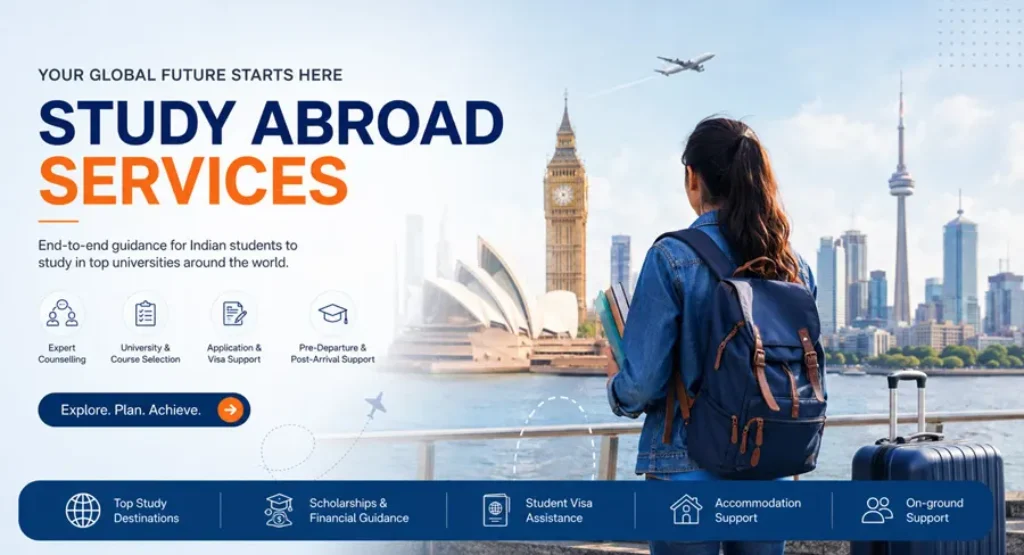
Studying abroad is a big decision. For an Indian student, it can mean choosing a country, a course, a university, and a budget that could shape the next several years of their academic and professional life.
The challenge is that there are simply too many options.
Should you study in the UK or Australia? Is Germany a better option for your course? Would a university in Italy make sense for a career in fashion or design? Should you choose a one-year master’s or a two-year program? How much will the complete education cost? Which universities are realistic for your academic profile? Do you need IELTS, TOEFL or PTE? What happens after you receive an offer? How should you prepare for your student visa?
These are the questions students and parents usually face when they begin exploring international education.
This is where professional Study Abroad Services can make the process easier to understand and manage.
At Eduvisor, we help Indian students make informed decisions about studying overseas, starting with their academic profile and career goals rather than simply recommending a popular country or university. Our role is to help you understand your options, compare them realistically and move through the admission process with proper planning.
From career and course counselling, university shortlisting and application assistance to scholarships, education loans, student visa guidance, accommodation and pre-departure support, our aim is to support the complete study abroad journey.
Whether you are planning to study in the UK, Australia, USA, Canada, Germany, Italy, Ireland, France, Netherlands, Sweden, Spain or another destination, the right starting point is not the country. It is understanding what you want to study, why you want to study it and which destination makes sense for you.
What Do Study Abroad Services Include?
Study Abroad Services are not limited to filling out a university application.
A good international education counselling process should help a student answer four basic questions:
What should I study?
Where should I study?
Which universities are realistic for my profile and budget?
How do I successfully complete the admission and visa process?
At Eduvisor, our support can cover the major stages of this journey, including:
- Profile evaluation
- Career and course counselling
- Country selection
- University and course shortlisting
- Eligibility assessment
- English-language test guidance
- Application planning
- Documentation assistance
- University application support
- Scholarship guidance
- Education loan and financial guidance
- Offer management
- Student visa assistance
- Accommodation assistance
- Pre-departure counselling
- Flight and travel assistance
- Airport pickup support
- Post-arrival assistance
The exact support required will depend on your course, destination, university, academic background and personal circumstances.
Our approach is simple: understand the student first, then build the study abroad plan around the student.
Why Do Indian Students Choose to Study Abroad?
For some students, the attraction is a particular university. For others, it may be a specialised course, international exposure, research opportunities, professional development or the possibility of building a global career.
There is no single reason why students choose international education.
Access to specialised courses
International universities offer a wide variety of specialised programs that may not always be available in the same format in India.
Students can explore fields such as:
- Artificial Intelligence and Machine Learning
- Computer Science
- Data Science
- Cybersecurity
- Business Analytics
- Finance
- Engineering
- Biotechnology
- Pharmaceutical Sciences
- Healthcare
- Fashion and Design
- Architecture
- Hospitality and Tourism
- Law
- Supply Chain Management
- Digital Marketing
- Media and Communication
- Renewable Energy
- Sustainability
- Robotics
- Management and Entrepreneurship
However, choosing a course simply because it is popular is rarely a good strategy.
A course needs to make sense in the context of your previous education, skills, interests and future career plans.
International academic exposure
Studying overseas gives students an opportunity to experience a different academic environment.
Depending on the university and course, students may work on practical projects, industry assignments, research activities, internships, case studies and group projects with classmates from different countries.
That exposure can help develop skills that extend beyond the classroom.
Career development
An international degree can provide exposure to new academic and professional environments. Students may also develop communication, teamwork, problem-solving, adaptability and cross-cultural skills.
But it is important to keep expectations realistic.
Studying abroad is not an automatic guarantee of employment, a high salary or permanent residency. Students should evaluate the course, university, destination, employment environment and applicable post-study regulations before making a major financial commitment.
Best Study Abroad Destinations for Indian Students
There is no single best country for every student.
The right destination depends on your course, academic profile, budget, career objectives, preferred lifestyle and long-term plans.
Here are some of the destinations Indian students commonly explore.
Study in the UK
The UK remains a popular choice for Indian students because of its internationally recognised universities and wide range of undergraduate and postgraduate programs.
One of the attractions for master’s students is the availability of many programs that can be completed in a relatively short period.
Popular areas include:
- Business and Management
- Computer Science
- Artificial Intelligence
- Engineering
- Finance
- Law
- Public Health
- Data Science
- Marketing
- International Business
- Design
If you are considering the UK, it is important to look beyond the university name. Course modules, tuition fees, location, accommodation, entry requirements and current student visa and post-study regulations should all form part of the decision.
Study in Australia
Australia is another major destination for Indian students, particularly for programs related to business, IT, engineering, healthcare, accounting and data science.
Before choosing Australia, students should understand:
- University and course suitability
- Tuition fees
- Living expenses
- English-language requirements
- Financial requirements
- Student visa requirements
- Health insurance
- Accommodation
- Current post-study work rules
Australian education and immigration requirements can change, so students should always check the latest official requirements before submitting an application or visa.
Study in the USA
The USA has one of the world’s largest higher education systems, with universities and colleges offering programs across almost every academic discipline.
It can be particularly attractive for students interested in:
- Computer Science
- Artificial Intelligence
- Data Science
- Engineering
- Business Analytics
- Finance
- MBA
- Biotechnology
- Research
- STEM programs
The US application process can also be more detailed than students initially expect. Depending on the university and program, students may need academic records, essays, recommendation letters, standardised tests, financial documentation and other supporting materials.
Study in Canada
Canada has been a popular international education destination for Indian students, offering universities, colleges and career-focused programs.
However, students considering Canada should pay close attention to current policies.
Important areas to evaluate include:
- Institution eligibility
- Program eligibility
- Tuition fees
- Living expenses
- Financial requirements
- Student visa rules
- Work regulations
- Post-study opportunities
- Provincial differences
Canadian international student policies have changed over time, so students should avoid making decisions based on older information or social media discussions.
Study in Germany
Germany is particularly interesting for students looking at engineering, technology and technical disciplines.
Popular areas include:
- Mechanical Engineering
- Automotive Engineering
- Computer Science
- Artificial Intelligence
- Data Science
- Renewable Energy
- Engineering
- Business
- Life Sciences
Germany also requires students to understand a somewhat different education and financial planning system compared with countries such as the UK, Australia or Canada.
Students may need to consider public and private universities, language requirements, academic recognition, financial requirements and program-specific admission conditions.
Study in Italy
Italy can be an excellent destination to explore for students interested in areas such as:
- Fashion Design
- Fashion Management
- Architecture
- Product Design
- Luxury Management
- Engineering
- Business
- Arts and Design
For students interested in fashion, design and creative disciplines, Italy offers a particularly interesting combination of academic education and industry exposure.
However, students should still compare tuition fees, scholarships, accommodation, language requirements and living costs before selecting a university.
Study in Ireland
Ireland is another destination worth considering, particularly for students interested in technology, business, pharmaceuticals, finance and data-related fields.
Its strong presence of international companies makes it relevant for students whose career interests align with sectors that have a significant presence in the country.
Other European Study Destinations
Students can also explore destinations such as:
- Netherlands
- France
- Sweden
- Spain
- Finland
- Other European countries
The important question is not simply “Which country is popular?”
The better question is:
“Which country offers the right combination of course, university, cost, academic environment and career relevance for me?”
Choosing the Right Course to Study Abroad
One of the biggest mistakes students make is starting the process by asking, “Which country should I go to?”
A better starting point is:
“What do I want to study and where can I study it well?”
For example, a student with a B.Tech in Computer Science could explore programs in Computer Science, Artificial Intelligence, Data Science, Cybersecurity, Software Engineering or Business Analytics.
A B.Com graduate might consider Finance, Accounting, Business Analytics, International Business or Management.
A student interested in fashion may look at Fashion Design, Fashion Management, Luxury Management or related creative programs.
The right course should have a logical connection with the student’s academic background and career plans.
Popular Study Abroad Courses
STEM and Technology
- Computer Science
- Artificial Intelligence
- Machine Learning
- Data Science
- Cybersecurity
- Information Technology
- Software Engineering
- Robotics
- Cloud Computing
Business and Management
- MBA
- International Business
- Business Analytics
- Finance
- Marketing
- Entrepreneurship
- Supply Chain Management
- Project Management
Engineering
- Mechanical Engineering
- Civil Engineering
- Electrical Engineering
- Electronics Engineering
- Automotive Engineering
- Chemical Engineering
- Environmental Engineering
Healthcare and Life Sciences
- Public Health
- Pharmacy
- Biotechnology
- Biomedical Sciences
- Nursing
- Healthcare Management
- Life Sciences
Design and Creative Programs
- Fashion Design
- Fashion Management
- Graphic Design
- Interior Design
- Architecture
- Product Design
- Hospitality Management
- Tourism Management
- Media and Communication
A course may be popular, but that does not necessarily make it suitable for you.
Your academic background, interests, skills, career goals, budget and the actual curriculum should all be considered.
Study Abroad Services for Undergraduate Students
For students planning to study abroad after Class 12, the decision-making process can be particularly important because they are making their first major academic choice.
At this stage, students may need help with:
- Understanding their academic profile
- Exploring suitable career directions
- Selecting courses
- Comparing countries
- Identifying universities
- Understanding entry requirements
- Planning English-language tests
- Preparing applications
- Preparing personal statements or essays
- Understanding scholarship opportunities
- Planning finances
- Managing offers
- Preparing for the student visa
- Arranging accommodation and travel
Parents are also an important part of the undergraduate decision-making process.
A good counselling discussion should therefore address both the student’s aspirations and the family’s practical considerations, especially around budget, safety, location and long-term career planning.
Study Abroad Services for Master’s and Postgraduate Students
Many Indian students begin their international education journey after completing a bachelor’s degree.
Options may include:
- Master’s degrees
- MBA programs
- Postgraduate diplomas
- Graduate certificates
- Professional programs
- Research programs
- Doctoral degrees
For postgraduate applicants, the counselling process normally needs to go deeper.
A student’s bachelor’s degree, grades, subjects, internships, projects, work experience, technical skills and career progression can all influence the choice of program.
The most important thing is to create a logical connection between:
Previous education → Proposed course → Career direction
That connection can also become important when preparing university applications and explaining the student’s academic progression.
How Eduvisor Helps Students Study Abroad
At Eduvisor, we believe the study abroad journey should begin with the student, not with a university brochure.
1. Profile Evaluation
We begin by understanding your:
- Academic background
- Qualifications
- Work experience, where applicable
- English-language proficiency
- Interests
- Budget
- Career objectives
This gives us a clearer picture of what options may realistically work for you.
2. Career and Course Counselling
Choosing the right course is often more important than choosing a country.
Our counselling focuses on your academic background, interests, skills, career aspirations, course curriculum, university strengths, budget and destination preferences.
3. Country Selection
Once the course direction is clearer, we can compare suitable destinations based on factors such as:
- Education quality
- Course availability
- Tuition fees
- Living costs
- Visa requirements
- Language
- Lifestyle
- Employment environment
- Post-study options
- Overall affordability
4. University Shortlisting
We help students build a practical university shortlist.
Instead of applying only to highly ranked universities, we recommend looking at a balanced range of options that may include ambitious, strong-fit and safer choices.
The shortlist can then be evaluated based on:
- Entry requirements
- Course structure
- Tuition fees
- Location
- University reputation
- Facilities
- Industry connections
- Career relevance
5. Application Assistance
Once the shortlist is finalised, the next step is preparing strong and accurate applications.
Depending on the university and course, support can include:
- Application forms
- Statement of Purpose
- Personal statements
- Resume/CV
- Recommendation letters
- Academic documents
- Portfolios
- Application submission
- Application tracking
6. Offer Management
Receiving an offer is an important milestone, but it is not necessarily the end of the decision-making process.
Students may receive conditional or unconditional offers.
We help students understand offer conditions, deadlines, deposits, tuition requirements and the next steps before making a final decision.
7. Scholarships and Financial Planning
Studying abroad requires proper financial planning.
The overall budget may include:
Tuition + Accommodation + Living Expenses + Insurance + Visa Costs + Flights + Study Materials + Personal Expenses
Depending on the student’s profile, scholarships, grants, education loans and other legitimate funding options may also be explored.
8. Student Visa Assistance
University admission and student visa approval are two different processes.
An admission offer does not automatically mean that a visa will be granted.
Visa requirements vary by destination and can include evidence related to admission, finances, identity, academic background, English proficiency, insurance, health requirements and other factors.
Eduvisor can help students organise their documentation and prepare for the relevant visa process. Students are always expected to meet the official requirements of the destination country.
9. Pre-Departure Support
Getting the visa is a major milestone, but there is still plenty to prepare before leaving India.
Students may need help with:
- Accommodation
- Flights
- Airport pickup
- International SIM
- Foreign exchange
- Travel insurance
- Health insurance
- Banking
- Local transportation
- Important documents
- Essential luggage
The objective is to help students arrive better prepared for their new academic environment.
Study Abroad Eligibility for Indian Students
There is no single eligibility rule for studying abroad.
Requirements depend on the country, university, course and level of study.
Academic qualifications
Undergraduate applicants may be assessed based on Class 10 and Class 12 qualifications.
Postgraduate applicants are generally assessed on their bachelor’s degree, academic performance, subjects studied and, in some cases, specific prerequisite subjects.
English-language requirements
Depending on the university and destination, students may need tests such as:
- IELTS
- TOEFL
- PTE Academic
- Other accepted English-language tests
Some universities may offer exemptions or alternative pathways in specific circumstances.
Standardised tests
Certain universities or programs may require or recommend:
- GRE
- GMAT
- SAT
- ACT
Requirements should always be checked against the specific course and university.
Work experience
Some MBA and professional programs may require or prefer applicants with relevant work experience.
Portfolio
Students applying for fashion, architecture, design, fine arts, media and other creative programs may need to submit a portfolio.
How Much Does It Cost to Study Abroad?
This is one of the first questions parents usually ask.
The honest answer is: it depends.
The cost can vary significantly depending on the country, university, course, city, duration and lifestyle.
Students should not look at tuition fees alone.
A more realistic calculation is:
Total Study Abroad Cost = Tuition + Accommodation + Living Expenses + Insurance + Visa + Travel + Study Materials + Personal Expenses
A student studying in a major metropolitan city may have substantially higher living costs than someone studying in a smaller university town.
This is why Eduvisor encourages students and parents to calculate the complete cost before accepting an offer.
Scholarships for Indian Students
Scholarships can make international education more affordable for eligible students.
Depending on the destination and university, students may find:
- Merit-based scholarships
- Need-based support
- University scholarships
- Government scholarships
- Country-specific scholarships
- Research funding
- Departmental scholarships
Eligibility may depend on academic performance, leadership, extracurricular achievements, financial circumstances, research potential or other criteria.
One important point: scholarship deadlines may be different from university application deadlines.
Students should therefore start researching funding options early.
Education Loans for Study Abroad
Education loans are another important part of financial planning for many Indian families.
Before choosing a loan, students should compare:
- Interest rates
- Processing fees
- Collateral requirements
- Margin money
- Repayment period
- Moratorium period
- Eligible expenses
- Disbursement process
- Currency considerations
Eduvisor can help students understand the basic financing options and prepare for discussions with lenders.
However, final loan approval depends on the lender’s eligibility criteria, documentation and internal assessment.
Student Accommodation Abroad
Accommodation is often overlooked until after admission and visa approval.
It should actually be considered much earlier, particularly when comparing the cost of different cities.
Students may choose from:
- University accommodation
- Private student residences
- Purpose-built student accommodation
- Shared apartments
- Homestays
- Private rentals
Before booking, look at more than just the monthly rent.
Consider:
- Distance from campus
- Deposit
- Utilities
- Contract duration
- Transport
- Safety
- Facilities
- Cancellation conditions
Having accommodation arranged before travelling can make the first few weeks in a new country considerably easier.
Why Choose Eduvisor for Study Abroad Services?
Choosing a study abroad consultant is itself an important decision.
At Eduvisor, we focus on making the process easier to understand rather than simply increasing the number of applications.
Student-first approach
Every student’s academic background, budget and career plans are different. Counselling should reflect that.
Course before country
We believe the course should have a clear purpose. The country should support that academic and career objective.
Multiple options
Students should be able to compare different universities and destinations before making a decision.
Practical financial planning
A university may look attractive until the complete cost is calculated. We encourage students to look at the full financial picture.
Transparent guidance
Students and parents should understand requirements, costs, timelines and limitations before making significant commitments.
Support beyond admission
The journey does not end when a university sends an offer. Visa preparation, accommodation, travel and pre-departure planning are equally important.
When Should You Start Your Study Abroad Planning?
Starting early gives students more choices.
A typical planning timeline could look like this:
12–18 months before intake
- Research countries
- Explore courses
- Evaluate your academic profile
- Research universities
- Estimate your budget
9–12 months before intake
- Finalise the shortlist
- Prepare for English-language tests
- Prepare documents
- Explore scholarships
- Start applications
6–9 months before intake
- Submit applications
- Track decisions
- Compare offers
- Plan finances
3–6 months before departure
- Accept the offer
- Pay required deposit
- Arrange education finance if required
- Prepare the visa application
- Finalise accommodation
1–3 months before departure
- Complete visa formalities
- Book flights
- Arrange insurance
- Prepare documents and luggage
- Attend pre-departure counselling
The exact timeline will vary by destination, university, course and intake.
Common Mistakes Students Make When Planning to Study Abroad
Choosing a university only because of its ranking
Rankings can be useful, but they should not determine the entire decision.
Choosing a popular course without understanding it
Read the curriculum. Look at modules, projects, assessments, internships and career relevance.
Looking only at tuition fees
A lower tuition fee does not necessarily mean a lower overall cost.
Starting too late
Applications, tests, scholarships, finances and visas all take time.
Using outdated visa information
Immigration rules change. Always check current official information.
Providing inconsistent information
Academic documents, applications, financial documents and visa information should be accurate and consistent.
Choosing a course only for migration
Career and academic suitability should remain the primary considerations.
Applying to only one university
A balanced shortlist gives students alternatives if their first choice does not work out.
Frequently Asked Questions About Study Abroad Services
What are Study Abroad Services?
Study Abroad Services provide professional guidance to students planning to pursue education overseas. They may include counselling, course selection, university shortlisting, application assistance, scholarships, financial guidance, student visa support, accommodation and pre-departure assistance.
Which country is best for Indian students?
There is no single best country. The right destination depends on your course, academic profile, budget, career goals, lifestyle preferences and the current education and immigration environment.
When should I start planning to study abroad?
Ideally, start researching at least 12 months before your intended intake. Students applying for competitive programs or scholarships may benefit from starting even earlier.
Can I study abroad after Class 12?
Yes. Students can apply for undergraduate programs in many countries after completing Class 12, subject to the university and course requirements.
Can I study abroad after graduation?
Yes. Indian graduates can explore master’s degrees, MBA programs, postgraduate qualifications, professional courses and research programs overseas.
Do I need IELTS to study abroad?
Not always. Requirements vary by university and country. Some institutions accept other English-language tests or provide exemptions under specific conditions.
Does Eduvisor help with student visas?
Yes. Eduvisor provides student visa guidance and documentation support as part of its Study Abroad Services. However, students must meet the official immigration requirements and the final visa decision rests with the relevant government authority.
Can Eduvisor help me get an education loan?
Eduvisor can help students understand education financing options and prepare for discussions with lenders. Loan approval depends on the lender’s eligibility criteria and assessment.
Does Eduvisor provide accommodation assistance?
Yes. Accommodation assistance can be provided as part of the pre-departure support, depending on the destination and available options.
Is studying abroad expensive?
The cost varies significantly. Tuition, accommodation, living expenses, insurance, visa costs, flights and personal expenses all need to be included when calculating the total budget.
Start Your Study Abroad Journey with Eduvisor
Studying abroad should not begin with a random list of universities.
It should begin with a clear understanding of your academic profile, career goals, preferred course and realistic budget.
Once those things are clear, choosing the right country and university becomes much easier.
Eduvisor’s Study Abroad Services are designed to support Indian students through the important stages of this journey, from profile evaluation and counselling to university selection, applications, financial planning, student visa guidance, accommodation and pre-departure support.
Whether you are a Class 12 student exploring your first international degree, a graduate planning a master’s, a working professional considering an MBA, or someone looking for a specialised international program, our counsellors can help you understand your options and plan the next step.
Ready to explore your study abroad options?
Book a Free Study Abroad Counselling Session with Eduvisor
Discuss your profile, preferred course, destination and budget with an Eduvisor counsellor and start building a study abroad plan that is right for you.