

SGPA to Percentage Calculator for Indian Students
Enter your SGPA or CGPA below to get an approximate percentage. The calculator also works out your CGPA from semester-wise SGPAs and credits. There is no single national formula, so pick the rule your university follows (or enter your own).
SGPA / CGPA to percentage calculator
Work out your CGPA from semester SGPAs
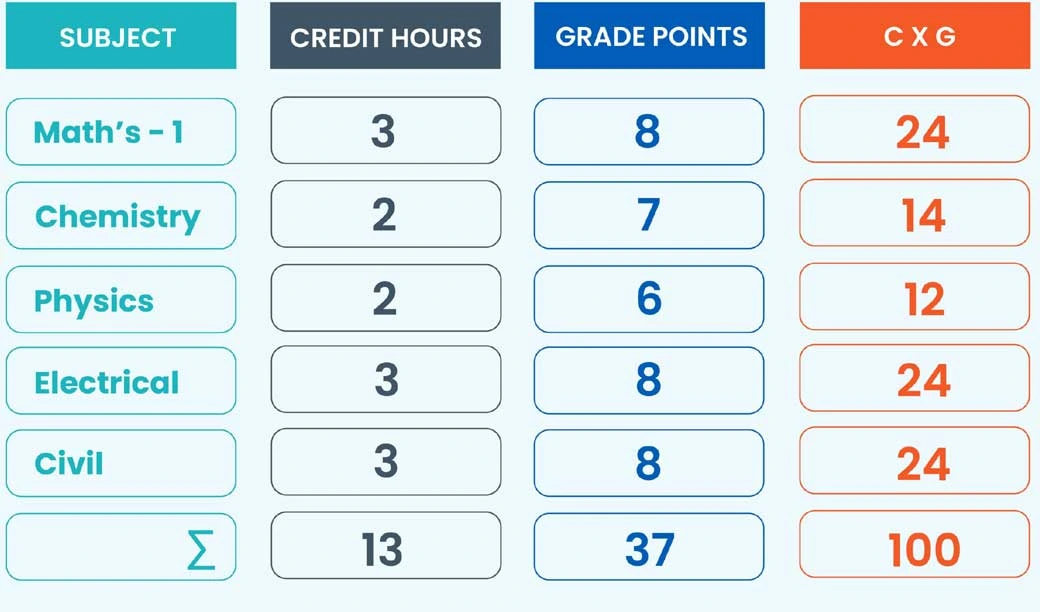
Enter each semester’s SGPA and its total credits. CGPA = sum of (SGPA × credits) ÷ total credits. The result uses the rule selected above.
Indicative result only. Universities revise their rules, so use the formula in your own university’s notification or transcript for official forms.
SGPA, CGPA and percentage: the quick answer
SGPA (Semester Grade Point Average) is your average grade point for one semester. CGPA (Cumulative Grade Point Average) is the credit-weighted average across all semesters completed. A percentage is not calculated from either by one national formula. Each university or board decides its own conversion, and some do not publish one at all.
How SGPA is calculated
SGPA = sum of (credits of each course × grade points earned) ÷ total credits of the semester. For example, three courses with 4, 3 and 3 credits and grade points of 9, 8 and 7 give (36 + 24 + 21) ÷ 10 = 8.1.
Common conversion rules, and why the results differ
The same grade can produce very different percentages depending on the rule. Here is an SGPA or CGPA of 8.2 under each rule in the calculator:
| Rule | Formula | Result for 8.2 |
|---|---|---|
| CBSE-style | CGPA × 9.5 | 77.9% |
| Simple multiplier | CGPA × 10 | 82% |
| Offset of 0.75 | (CGPA − 0.75) × 10 | 74.5% |
| Offset of 0.5 | (CGPA − 0.5) × 10 | 77% |
| University of Mumbai (engineering) | 7.1 × CGPA + 11 | 69.22% |
That is a spread of almost 13 percentage points for the same grade. Education portals often list these rules against specific universities, but the lists disagree with each other and universities revise their schemes. The reliable source is always your own university’s notification, your transcript or the examination department.
What if my university has no official formula?
Ask the examination or registrar’s office for a written conversion statement (often called a CGPA-to-percentage equivalence letter). Employers, Indian universities and visa or admission offices accept this more readily than a figure you worked out yourself. Keep the transcript, grading scale and this letter together in one file.
Applying abroad: do you even need a percentage?
Often you do not. Many universities abroad ask for your transcript and grading scale and run their own evaluation. A few examples of how it differs:
- United Kingdom: each university publishes the grades it expects from Indian applicants on its country page, usually as a percentage or class. Check the specific course page.
- United States: universities usually accept your CGPA with the scale stated. Some ask for a credential evaluation, but this depends on the university.
- Germany: grades are commonly converted with the modified Bavarian formula: x = 1 + 3 × (Nmax − Nd) ÷ (Nmax − Nmin), where Nmax is the best possible grade, Nmin the lowest passing grade and Nd your grade. The exact method is set by the university or application service you apply through.
Use this calculator for a rough idea, then follow each university’s own instructions. Our guide to study abroad colleges with higher acceptance rates is a useful next read if your grades are modest.
Frequently asked questions
Is SGPA the same as CGPA?
No. SGPA covers one semester. CGPA covers all completed semesters, weighted by credits. After your first semester the two are the same number.
Is there an official formula to convert SGPA to percentage?
Not one that applies everywhere. CBSE uses a multiplier of 9.5 for its Class 10 CGPA, but universities set their own rules for semester grades. Always confirm with your university.
Which formula should I use for a job or admission form?
Use your university’s official formula. If none exists, ask for an equivalence letter and mention it on the form.
Will a foreign university use my calculated percentage?
Usually it applies its own method to your transcript and grading scale. Your calculated figure is a guide for choosing where to apply, not a substitute for the official document.
Not sure whether your grades fit the universities you like?
Eduvisor’s counselling team can look at your marks, course and goals and explain which universities in India or abroad are realistic. Start with a free profile assessment or contact our team.